
10 Easy Home Workouts for Beginners: A Simple Routine You Can Actually Stick With
The first time I tried working out at home, I made the classic beginner mistake: I went way too hard.
I found a challenging workout online, followed along for nearly 30 minutes, and felt proud of myself afterward. The next morning, though, walking down the stairs felt like a workout of its own. My legs were sore, my motivation disappeared, and I ended up skipping exercise for several days.
That experience taught me something important: a good beginner workout isn’t the one that leaves you exhausted. It’s the one you can comfortably repeat.
You don’t need a gym membership, expensive equipment, or a complicated workout plan to get started. A little floor space, comfortable clothes, and 15–30 minutes can be enough.
If you’re new to exercise, these 10 easy home workouts are a practical place to begin.
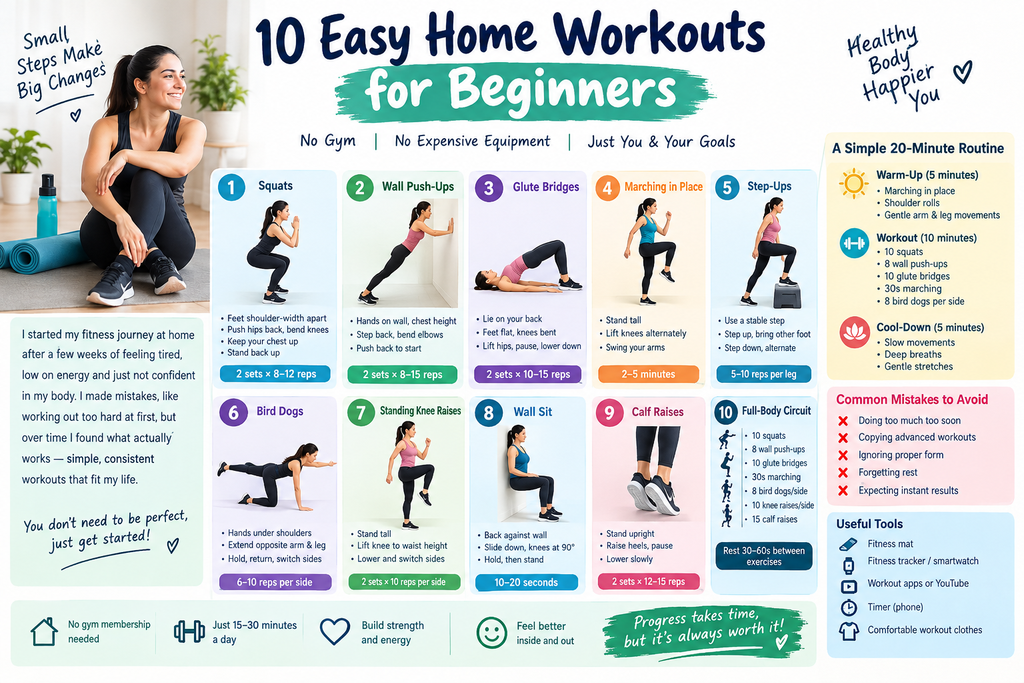
1. Bodyweight Squats
Squats are one of the easiest exercises to add to a home routine because you don’t need any equipment.
They work several muscles in your lower body and also teach you how to control your movement.
How to do them:
- Stand with your feet about shoulder-width apart.
- Keep your chest comfortably upright.
- Push your hips back as if you’re sitting in a chair.
- Bend your knees and lower yourself as far as feels comfortable.
- Push through your feet to return to standing.
- Repeat slowly.
Beginner target: 2 sets of 8–12 repetitions.
One mistake I made early on was trying to squat too deeply before I was comfortable with the movement. You don’t have to force your body into a certain position. Start with a comfortable range and gradually improve.
If balance is difficult, place a sturdy chair behind you and use it as a reference for the movement.
2. Wall Push-Ups
Regular push-ups can feel surprisingly difficult when you’re just starting. Wall push-ups are a much more beginner-friendly alternative.
They allow you to practice the pushing movement while putting less body weight through your hands and arms.
How to do them:
- Stand facing a clear wall.
- Place your hands against the wall around chest height.
- Take a small step backward.
- Bend your elbows and slowly bring your chest toward the wall.
- Push yourself back to the starting position.
- Keep your body controlled instead of rushing.
Beginner target: 2 sets of 8–15 repetitions.
As this becomes easier, you can move your feet farther away from the wall. Later, you might progress to incline push-ups using a sturdy elevated surface.
3. Glute Bridges
If you’ve spent much of the day sitting, glute bridges can be a useful addition to your home routine.
You simply need a comfortable floor or exercise mat.
How to do them:
- Lie on your back.
- Bend your knees and place your feet flat on the floor.
- Keep your arms relaxed beside you.
- Gently lift your hips toward the ceiling.
- Pause briefly at the top.
- Lower your hips slowly.
Beginner target: 2 sets of 10–15 repetitions.
Don’t worry about lifting your hips as high as possible. Controlled movement is more important than height.
An exercise mat can make floor exercises much more comfortable, especially if you have hard flooring at home.
4. Marching in Place
Not every workout needs to involve complicated movements.
Marching in place is one of the simplest ways to add movement to your day, and it’s particularly useful when you don’t have much room.
Try this:
- Stand tall with your feet comfortable apart.
- Lift one knee slightly.
- Lower it and lift the opposite knee.
- Continue alternating.
- Swing your arms naturally.
- Maintain a pace that allows you to breathe comfortably.
Start with 2–5 minutes, depending on your fitness level.
I like this exercise as a warm-up because you can easily control the pace. If you’re feeling tired, slow down. If it feels too easy, gradually increase the pace.
You can even march while listening to music or following a beginner routine on YouTube.
5. Step-Ups
If you have a stable, secure step available, step-ups can be a simple way to work your legs while getting your body moving.
Safety matters here. Don’t use a slippery chair, unstable table, or anything that can easily move.
How to do step-ups:
- Stand in front of a stable step.
- Place one foot firmly on it.
- Bring the other foot up.
- Step back down carefully.
- Alternate which foot leads.
Start with 5–10 repetitions per leg.
When I first included step-ups in a home workout, I discovered that going slower actually made the exercise feel more controlled. Speed isn’t the goal. Stable, deliberate movements are much better for beginners.
6. Bird Dogs
Bird dogs are a simple bodyweight movement that challenges your balance and coordination.
They may look easy when you watch someone else doing them, but maintaining control can take practice.
How to do them:
- Start on your hands and knees.
- Place your hands under your shoulders.
- Keep your knees underneath your hips.
- Slowly extend one arm and the opposite leg.
- Hold the position briefly.
- Return to the starting position.
- Switch sides.
Try 6–10 repetitions per side.
The biggest lesson here is not to rush. Beginners often lift their arm and leg too high and lose their balance. Keep the movement controlled and make the range smaller if necessary.
7. Standing Knee Raises
Standing knee raises are another convenient exercise for a small room.
They’re particularly useful if getting down onto the floor isn’t comfortable.
How to do them:
- Stand upright.
- Keep your feet about hip-width apart.
- Lift one knee toward your waist as comfortably as possible.
- Lower it slowly.
- Repeat on the other side.
- Continue alternating.
Try 2 sets of 10 repetitions per side.
You can hold onto a wall or sturdy piece of furniture if you need extra balance.
Don’t worry about getting your knees extremely high. The goal is controlled movement that feels appropriate for your current fitness level.
8. Wall Sit
Wall sits require no equipment and very little space.
They’re also a good reminder that an exercise doesn’t need lots of movement to be challenging.
Here’s the basic setup:
- Stand with your back against a wall.
- Slowly slide down.
- Keep your feet firmly on the floor.
- Stop at a comfortable position.
- Hold the position for several seconds.
- Push through your feet to stand again.
If you’re a complete beginner, start with 10–20 seconds.
You don’t need to force yourself to hold the position for a minute. I learned pretty quickly that chasing a longer time often ruined my form. Short, controlled sets are a better starting point.
9. Calf Raises
Calf raises are extremely simple and can be performed almost anywhere.
How to do them:
- Stand upright with your feet about hip-width apart.
- Hold onto a wall if you need balance.
- Slowly raise your heels.
- Pause at the top.
- Lower your heels under control.
- Repeat.
Aim for 2 sets of 12–15 repetitions.
Try not to bounce through the movement. A slower pace makes it easier to stay in control.
If you’re exercising barefoot on a hard floor and find it uncomfortable, wearing supportive athletic shoes or using a fitness mat can help.
10. Gentle Full-Body Circuit
Once you’ve tried the individual exercises, you can combine several of them into a simple beginner circuit.
Here’s one routine you can try:
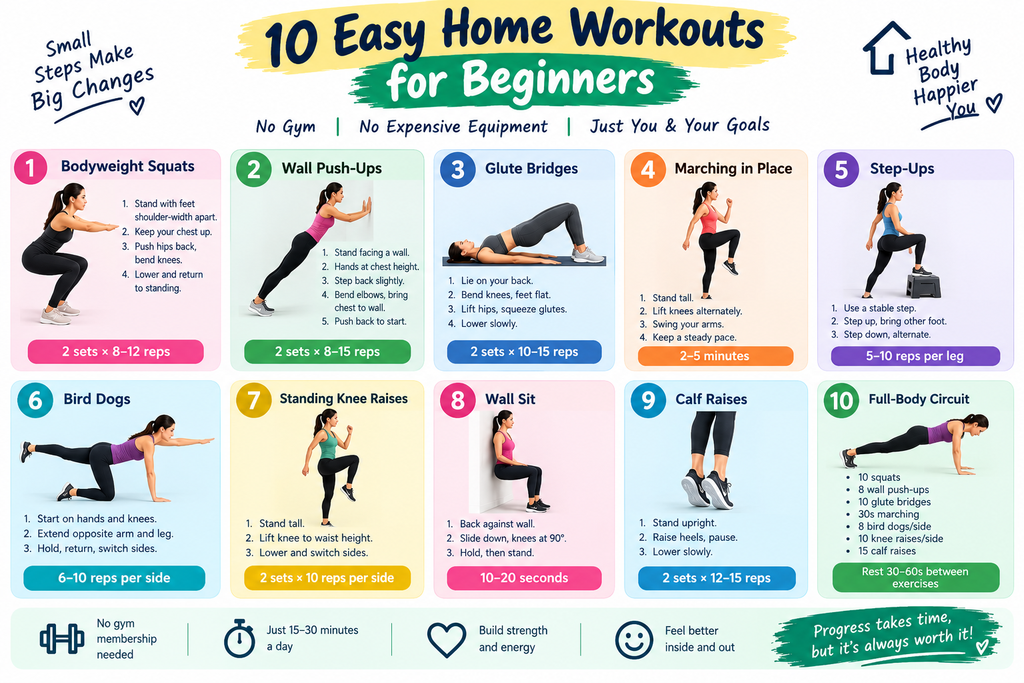
- 10 bodyweight squats
- 8 wall push-ups
- 10 glute bridges
- 30 seconds marching in place
- 8 bird dogs per side
- 10 standing knee raises per side
- 15 calf raises
Rest for 30–60 seconds between exercises if needed.
Complete one round first. If you feel comfortable, rest for a couple of minutes and repeat the circuit.
There’s no need to complete five rounds just because an online workout says so. Your starting point should match your current fitness level.
A Simple 20-Minute Beginner Home Workout
If choosing exercises feels overwhelming, here’s an easy structure you can follow.
Warm-up — 5 minutes
Start with:
- Marching in place
- Shoulder rolls
- Gentle arm movements
- Easy leg movements
The goal is simply to get moving gradually.
Workout — 10 minutes
Perform:
- 10 squats
- 8 wall push-ups
- 10 glute bridges
- 30 seconds marching
- 8 bird dogs per side
Rest whenever you need to.
Cool-down — 5 minutes
Slow your movement down and take comfortable breaths. You can finish with gentle stretches that feel comfortable for you.
This doesn’t need to be a perfect workout. Finishing a manageable routine consistently is more useful than completing one brutal workout and avoiding exercise for the rest of the week.
Common Beginner Mistakes to Avoid
Starting exercise is exciting, but a few common mistakes can make the process unnecessarily difficult.
Doing Too Much Too Soon
This is probably the biggest mistake.
You might feel motivated on Monday and decide to exercise for an hour. By Wednesday, you’re exhausted and don’t want to continue.
Instead, start with 15–20 minutes and build gradually.
Copying Advanced Workouts
Someone performing 50 squats, burpees, push-ups, and jumping exercises online may have been training for years.
You don’t need to match their workout.
Choose movements that fit your current ability and gradually increase the challenge.
Ignoring Form
Doing more repetitions isn’t automatically better.
If your movement becomes uncontrolled, take a break. Quality matters more than chasing a number.
A full-length mirror can sometimes help you observe your basic posture, but don’t become obsessed with watching yourself. Focus on moving comfortably and deliberately.
Forgetting Rest
Your body needs recovery.
You don’t have to exercise intensely every day. Beginners can alternate workout days with walking, gentle mobility work, or complete rest.
Expecting Instant Results
One week of exercise won’t completely transform your body.
Fitness is built through repeated habits. Improvements may show up first as better stamina, easier movement, improved confidence, or the ability to perform more repetitions comfortably.
Those small changes count.
Useful Tools for Home Workouts
You don’t need much equipment, but a few simple tools can make exercising at home easier.
A fitness mat provides a more comfortable surface for exercises such as glute bridges and bird dogs.
A basic fitness tracker or smartwatch can help you monitor steps, activity time, and workout consistency.
You can also use workout apps or beginner-friendly YouTube videos for guided routines. Just make sure the instructor demonstrates movements clearly and offers modifications for beginners.
A simple timer on your phone is enough for exercises such as wall sits or marching.
The equipment shouldn’t become another reason to postpone starting.
How Often Should Beginners Exercise?
You don’t need to work out every day.
A practical starting point is 2–3 home strength sessions per week, with walking or other comfortable physical activity on other days.
For example:
Monday: Beginner home workout
Tuesday: Easy walk
Wednesday: Rest or gentle movement
Thursday: Beginner home workout
Friday: Easy walk
Saturday: Optional light workout
Sunday: Rest
Adjust this based on how your body feels and your current activity level.
If you haven’t exercised for a long time, have an injury, or have a medical condition that could affect exercise, it’s sensible to speak with a healthcare professional before starting a new workout routine.
What I Wish I Knew When I Started
The biggest lesson I’ve learned from beginner workouts is that consistency beats intensity.
You don’t have to sweat heavily every time. You don’t need expensive equipment. You don’t need to feel completely exhausted when you’re finished.
Some days, ten minutes may be all you can manage. That’s okay.
The important part is building a routine that fits into your real life. Once the exercises start feeling easier, you can gradually add repetitions, another round, resistance bands, or more challenging variations.
And if you miss a workout, don’t treat it like you’ve failed.
Just start again the next day.
A few squats in your living room today might not feel like much, but those small sessions can become the foundation of a much stronger and more active routine over time.