
10 Best Full-Body Exercises for Beginners
When I first started exercising regularly, I made the same mistake many beginners make: I thought I needed a complicated workout plan to see progress.
I would jump from one exercise to another, try movements that were too difficult, and then wonder why I felt exhausted after a few sessions. The funny thing was that some of the simplest exercises were the ones that helped me build the most consistency.
If you’re new to fitness, you don’t need a gym full of machines or an hour-long workout every day. A handful of basic movements can train your legs, arms, chest, back, shoulders, and core while helping you become more comfortable with exercise.
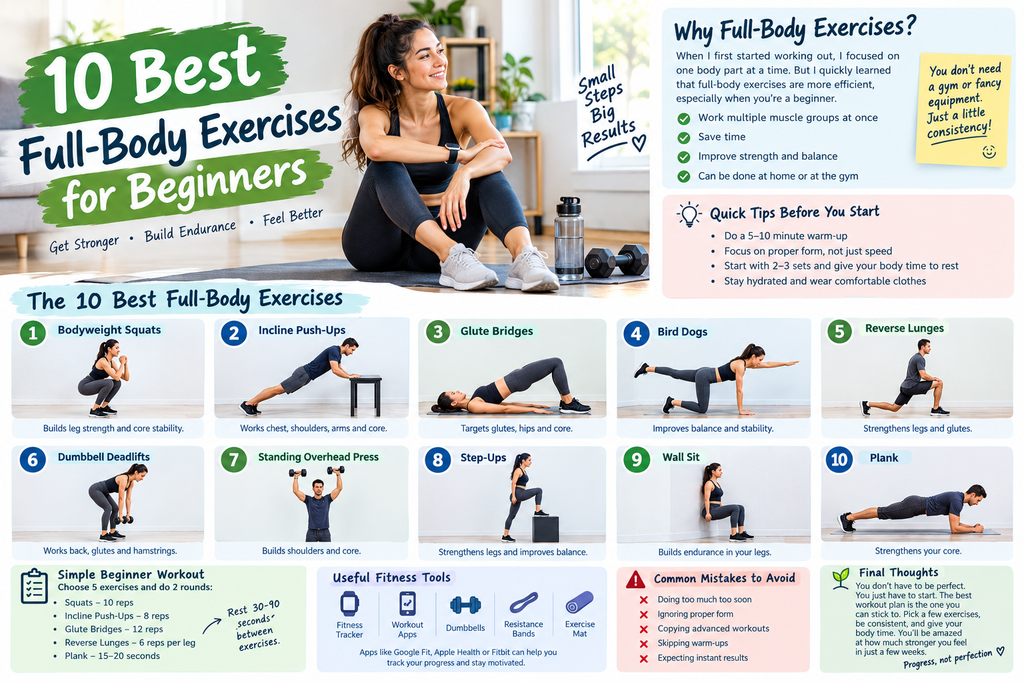
Here are 10 of the best full-body exercises for beginners, along with simple instructions and tips for doing them safely.
Why Full-Body Exercises Are Great for Beginners
Full-body exercises are useful because they involve several muscle groups at the same time.
For example, a squat doesn’t only work your legs. Your core has to help stabilize your body, and your upper body has to maintain good posture. A push-up works your chest, shoulders, arms, and core together.
This makes full-body movements a practical choice if you don’t have much time for exercise.
They’re also easy to build into a home workout. You can start with bodyweight exercises and gradually add equipment such as resistance bands or dumbbells when you become more comfortable.
The biggest lesson I learned was not to rush the process. Doing 10 controlled repetitions is usually more useful than trying to force out 25 sloppy ones.
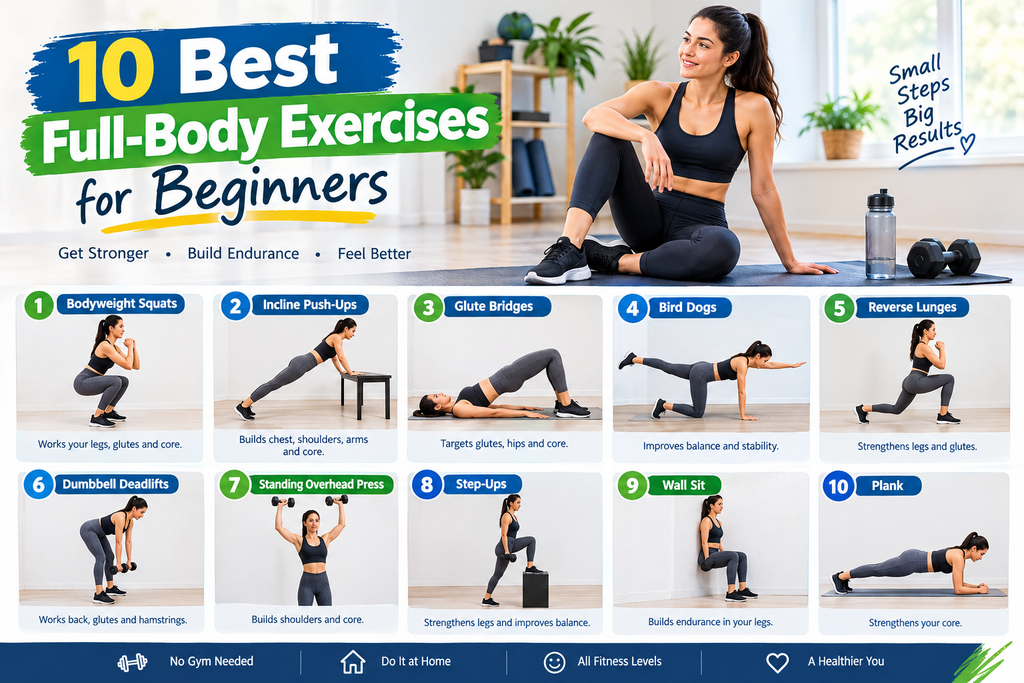
1. Bodyweight Squats
Squats are one of the first exercises I recommend to beginners because they’re simple, require no equipment, and can be modified easily.
They mainly work the thighs and glutes while also requiring your core to stay engaged.
How to do a bodyweight squat
- Stand with your feet around shoulder-width apart.
- Keep your chest comfortably upright.
- Push your hips backward as if you’re going to sit on a chair.
- Bend your knees and lower yourself as far as you can comfortably control.
- Keep your feet planted on the floor.
- Push through your feet to return to the starting position.
Start with 2–3 sets of 8–12 repetitions.
Don’t worry if you can’t squat very deeply at first. Your range of motion can improve as your mobility and strength develop.
Beginner mistake to avoid
Don’t let your entire movement become a quick drop-and-bounce. Slow down and stay in control.
If regular squats feel difficult, try sitting down onto a sturdy chair and standing back up. This can help you learn the movement pattern.
2. Incline Push-Ups
Regular push-ups can be surprisingly difficult when you’re just starting. I remember seeing beginners struggle with one or two repetitions and then giving up because they thought they simply weren’t strong enough.
The better approach is to change the angle.
Incline push-ups can be performed against a sturdy table, countertop, or bench.
How to do them
- Place your hands on a stable elevated surface.
- Walk your feet backward until your body forms a straight line.
- Tighten your stomach gently.
- Bend your elbows and bring your chest toward the surface.
- Push yourself back to the starting position.
Try 2–3 sets of 6–12 repetitions.
As you become stronger, use a lower surface. Eventually, you may be ready to try push-ups from the floor.
3. Glute Bridges
If you spend a lot of time sitting during the day, glute bridges are a useful exercise to add to your routine.
They primarily train the glutes and also involve the muscles around your hips and core.
How to do a glute bridge
- Lie on your back with your knees bent.
- Place your feet flat on the floor.
- Keep your arms relaxed beside you.
- Tighten your core gently.
- Press through your feet and lift your hips.
- Pause briefly at the top.
- Lower your hips slowly.
Aim for 2–3 sets of 10–15 repetitions.
One thing I learned with this exercise is that higher isn’t always better. You don’t need to throw your hips as high as possible. Focus on a controlled movement instead.
4. Bird Dogs
Bird dogs may look easy, but maintaining balance while moving opposite limbs can make your core work harder than expected.
They’re particularly useful for beginners who want to practice stability and coordination.
How to do a bird dog
- Start on your hands and knees.
- Keep your hands under your shoulders.
- Keep your knees under your hips.
- Slowly extend one arm forward.
- At the same time, extend the opposite leg backward.
- Hold briefly.
- Return to the starting position.
- Repeat on the other side.
Try 6–10 repetitions per side.
The goal isn’t to move quickly. If your hips start rotating from side to side, slow down and reduce the range of motion.
5. Reverse Lunges
Lunges are excellent for training the lower body, but forward lunges can sometimes feel awkward for beginners.
Reverse lunges are often easier to control because you step backward instead of forward.
How to perform a reverse lunge
- Stand tall with your feet comfortable apart.
- Take one leg backward.
- Lower your body by bending both knees.
- Keep your front foot stable.
- Push through the front foot to return to standing.
- Switch sides.
Start with 2 sets of 6–10 repetitions per leg.
If balance is difficult, place one hand lightly on a wall or sturdy piece of furniture.
Don’t worry about making the movement perfect immediately. Balance usually improves with practice.
6. Dumbbell Deadlifts
If you have a pair of light dumbbells at home, deadlifts can be a great addition to a beginner workout.
They train the muscles along the back of your body, including the glutes and hamstrings.
You don’t need heavy weights to learn the movement.
How to do a beginner dumbbell deadlift
- Stand with a dumbbell in each hand.
- Keep your feet about hip-width apart.
- Keep your back in a comfortable neutral position.
- Push your hips backward.
- Allow your knees to bend slightly.
- Lower the dumbbells along your legs.
- Stop when you feel a comfortable stretch in the back of your legs.
- Push through your feet and bring your hips forward to stand.
Start with a weight you can control comfortably for 8–12 repetitions.
If you aren’t confident about your technique, practice the movement without weights first.
A common beginner mistake is treating a deadlift like a squat. The hips should move backward rather than simply dropping straight down.
7. Standing Overhead Press
You don’t need a barbell to train your shoulders. A pair of light dumbbells can work well for beginners.
The standing overhead press also requires your core to help stabilize your body.
How to do it
- Stand tall with a dumbbell in each hand.
- Bring the weights to around shoulder level.
- Keep your stomach gently engaged.
- Press the dumbbells upward.
- Avoid aggressively arching your lower back.
- Lower the weights slowly.
Try 2–3 sets of 8–12 repetitions.
Use light weights at first. Your goal should be controlled repetitions rather than seeing how much weight you can lift.
8. Step-Ups
Step-ups are one of the most practical exercises because the basic movement is something you already do in everyday life.
You’ll need a stable, non-slippery step or platform.
How to perform step-ups
- Stand in front of a stable step.
- Place one foot firmly on it.
- Push through that foot and bring your other foot up.
- Step down carefully.
- Repeat on the opposite side.
Start with 6–10 repetitions per leg.
The height of the step matters. Beginners should use a height that allows them to maintain good control.
If you’re wobbling or using momentum to get up, choose a lower step.
9. Wall Sit
The wall sit is different from most of the exercises on this list because you’re holding a position instead of repeatedly moving.
It’s simple but can make your legs work surprisingly hard.
How to do a wall sit
- Stand with your back against a wall.
- Slowly slide your back down.
- Find a comfortable position where your thighs are working.
- Keep your back against the wall.
- Hold the position.
- Push through your feet to stand back up.
Beginners can start with 15–30 seconds for 2–3 sets.
You don’t have to force yourself into a very deep position. A comfortable angle that you can control is perfectly fine when you’re starting.
10. Plank
The plank is a simple way to train your core without equipment.
However, one of the biggest mistakes beginners make is holding a plank for as long as possible while their technique gradually falls apart.
Quality matters more than the timer.
How to do a beginner plank
- Start on your forearms and knees.
- Extend your legs behind you if you can maintain good form.
- Keep your body reasonably straight.
- Tighten your stomach gently.
- Keep your hips from dropping toward the floor.
- Breathe normally.
- Stop when you can no longer maintain good form.
Start with 10–20 seconds and gradually increase the time.
You can also perform the plank with your knees on the floor if a full plank is too challenging.
A Simple Beginner Full-Body Workout
You don’t have to perform all 10 exercises in one session.
For a simple workout, choose five movements:
- Bodyweight squats — 10 repetitions
- Incline push-ups — 8 repetitions
- Glute bridges — 12 repetitions
- Reverse lunges — 6 per leg
- Plank — 15–20 seconds
Rest for around 30–90 seconds between exercises as needed.
Complete 2 rounds at first.
If that feels manageable after a few sessions, you can gradually work toward 3 rounds.
The goal isn’t to finish completely exhausted. You should finish feeling like you worked hard but could still function normally afterward.
How Often Should Beginners Do Full-Body Workouts?
For most beginners, 2–3 full-body strength sessions per week can be a practical starting point.
You don’t need to exercise intensely every day.
On the days between workouts, you could take a walk, do gentle mobility work, or simply give your body time to recover.
Recovery is part of training. When I first started exercising, I thought soreness meant the workout had been successful. Eventually I realized that constantly chasing soreness wasn’t a good measure of progress.
Better signs include improved control, better endurance, gradually increasing repetitions, and feeling more comfortable with the movements.
Common Beginner Mistakes to Avoid
Doing too much too soon
This is probably the biggest mistake.
A beginner may feel motivated on Monday and complete a huge workout, only to be extremely sore by Wednesday and skip the rest of the week.
Start smaller.
Consistency beats one massive workout.
Ignoring technique
Don’t sacrifice your form just to complete extra repetitions.
If an exercise feels awkward, reduce the repetitions or make the exercise easier.
Trying to copy advanced workouts
Social media is full of impressive workouts, but you don’t need to perform advanced movements just because someone online makes them look easy.
Build your foundation first.
Forgetting warm-ups
You don’t necessarily need a complicated 20-minute warm-up.
A few minutes of easy movement, such as walking, marching in place, or gentle bodyweight movements, can help you transition into your workout.
Expecting instant results
Your first few weeks are about building the habit and learning the movements.
Changes in strength, fitness, and body composition take time. If fat loss is one of your goals, remember that exercise is only one part of the picture. Your overall eating pattern, sleep, daily activity, and consistency matter too.
Useful Fitness Tools for Beginners
You don’t need expensive equipment, but a few simple tools can make training easier to track.
A basic fitness tracker or smartwatch can help you monitor activity and workouts. Apps such as Google Fit, Apple Health, or Fitbit can also help you keep an eye on daily movement and exercise habits, depending on the device you use.
For strength training at home, a resistance band, exercise mat, and a pair of adjustable dumbbells can be enough for many beginner workouts.
A simple notes app can work too. Write down your exercises, repetitions, and how difficult the workout felt.
That’s actually one of the easiest ways to see progress.
What If You Can’t Do Some of These Exercises?
That’s completely normal.
Every exercise can be adjusted.
Can’t do a floor push-up? Use an incline.
Can’t balance during lunges? Hold onto something stable.
Can’t hold a plank for 30 seconds? Start with 10 seconds.
Don’t have dumbbells? Begin with bodyweight movements.
The best beginner exercise is often the version you can perform safely and consistently.
A Few Safety Tips
Pay attention to how your body feels during exercise.
Normal effort can include muscle fatigue and a feeling of working hard. Sharp, sudden, or unusual pain is different and shouldn’t simply be pushed through.
If you have an existing medical condition, an injury, or you’re unsure whether a particular exercise is appropriate for you, consider speaking with a qualified healthcare professional before starting a new exercise program.
And remember: you don’t need to prove anything during your first workout.
Start where you are.
The Approach That Makes Exercise Easier
The biggest change usually isn’t finding the perfect exercise. It’s making exercise easy enough to repeat.
Pick a few movements from this list. Learn the technique. Keep the workout short enough that you’re not constantly looking for excuses to skip it.
Then, over time, add repetitions, increase the difficulty, or introduce light resistance.
That’s how a beginner workout gradually becomes a real fitness routine.
You may not notice a dramatic difference after your first few sessions, and that’s okay. One day you’ll realize that the exercise that once felt difficult has become much easier.
That’s the kind of progress worth paying attention to.